April 28, 2026 • Maria Russo • 9 min reading time • Prices verified June 24, 2026
Complete Drip Irrigation Kits for Raised Beds: What the Box Actually Includes and Where Each Kit Falls Short
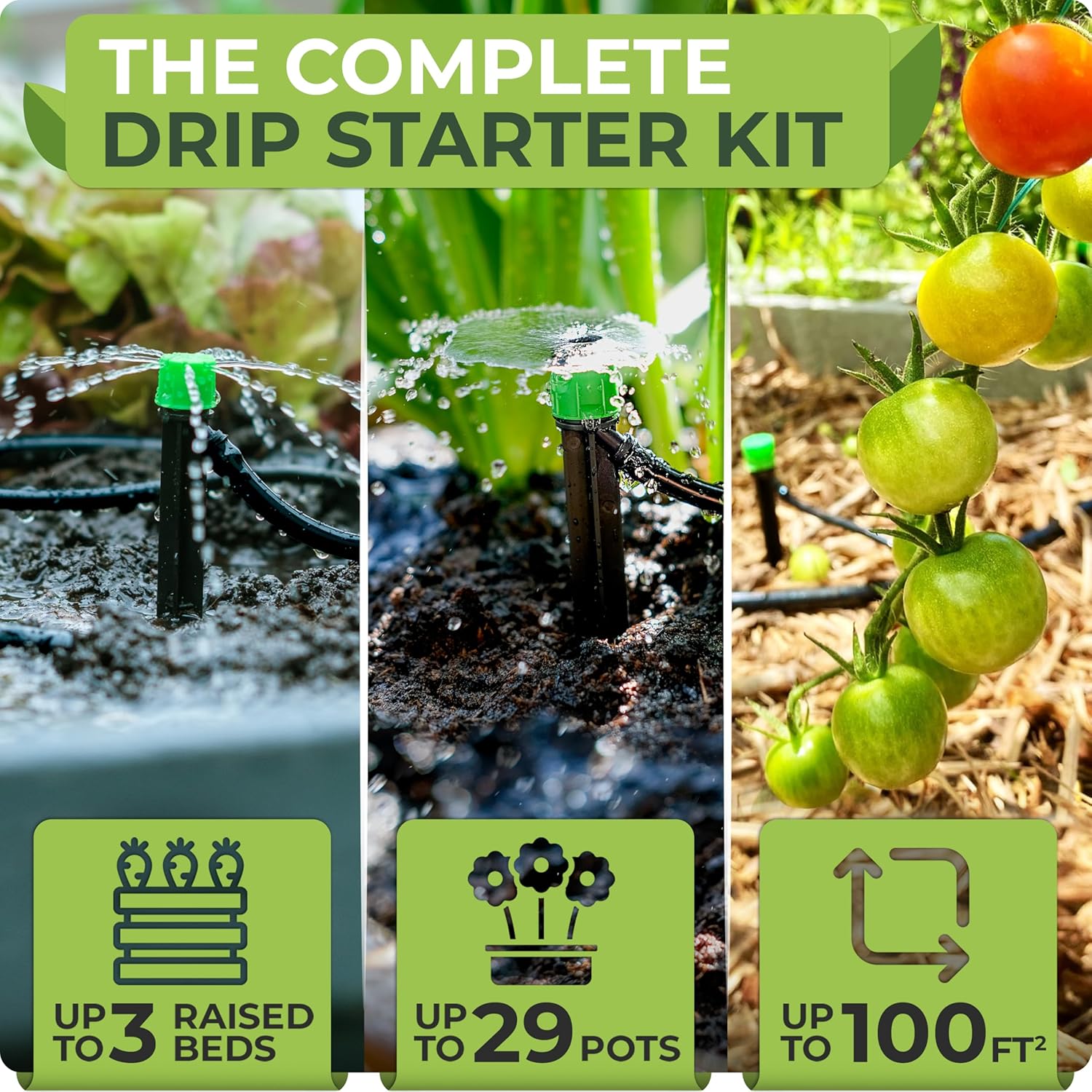
If you bought a boxed drip irrigation kit from a hardware store shelf or an online listing, you already know the experience: the packaging promises a complete system, you get home, and somewhere around step three you’re staring at a handful of parts that clearly weren’t designed to talk to each other. Drip irrigation — the practice of delivering water slowly and directly to a plant’s root zone through small tubes and emitters (the tiny outlets that release water drop by drop) rather than spraying it overhead — is genuinely one of the most efficient ways to water a raised garden bed. The EPA WaterSense program’s outdoor water use fact sheet notes that landscape watering accounts for nearly a third of residential water use nationwide, and well-designed drip systems can cut that figure by 30–50 percent versus overhead spray. This guide cuts through the marketing copy on the four most common boxed kit categories, tells you exactly what each one contains, and names the gaps you’ll almost certainly need to fill before your beds run reliably.
Why “Complete” Rarely Means Complete
The word “complete” on kit packaging means the components inside can theoretically form a closed loop from hose bib (the outdoor spigot on your house wall) to emitter — nothing more. What the manufacturer cannot know is your bed layout, your water pressure, or whether you already own a backflow preventer (a device that stops contaminated water from flowing backward into your home’s drinking supply — required by plumbing code in most municipalities).
The Utah State University Extension guide on micro-irrigation makes this gap explicit: it recommends a four-part baseline for any raised-bed drip system — backflow preventer, pressure regulator, filter, and distribution tubing — and notes that only one or two of those four are reliably included in most retail kits.
Understanding what a kit actually ships with versus what it assumes you own is the single most important lens for comparing price tags across brands.
The Four Kit Tiers: What’s in the Box
Tier 1 — Entry-Level Hose-Timer Bundles ($25–$60)
Brands in this range: Orbit, Melnor, Gilmour.
Typical contents: battery-operated hose timer, 25–50 ft of ½-inch polyethylene (poly) mainline tubing, 10–25 emitters (usually adjustable 0–10 GPH), barbed fittings, and a handful of ¼-inch “spaghetti” tubing for lateral runs to individual plants.
What’s missing almost universally: a pressure regulator, a filter, and a backflow preventer. None of these kits ship with a mesh filter — and emitters in the 0.5 to 2 GPH range clog from sediment faster than any other component in the system. The UC ANR drip irrigation publication states that a 150–200 mesh filter is the minimum recommended for emitter systems; without one, you’re on a clock toward partial or total emitter failure.
The math: A replacement emitter costs $0.25–$0.80. A quality inline filter costs $8–$15. If you’re running 20 emitters and lose half of them to clogging in a season, the filter pays for itself before summer ends.
Who it fits: A first-time gardener with one or two 4×8 raised beds, municipal water pressure in the 40–60 PSI range, and a willingness to buy the three missing pieces separately. Budget $20–$35 on top of the kit price to close the gaps.
Tier 2 — Mid-Range Drip Kits ($60–$120)
Brands in this range: Raindrip, DIG, Orbit’s upper lines.
Typical contents: This tier usually ships with a pressure regulator (rated to reduce incoming pressure to 25–30 PSI, which most emitters need to operate accurately), a mesh filter, and a larger component count — often 50–100 emitters of mixed flow rates, multiple sizes of tubing, goof plugs (used to seal holes you drilled in the wrong spot), and stakes. Some kits include a rudimentary hose-end timer.
What’s missing: A backflow preventer is still conspicuously absent from most mid-tier kits as of mid-2026. The Irrigation Association’s Landscape Irrigation Best Management Practices document calls backflow prevention “non-negotiable” for any system connecting to potable water lines — and raised beds are a high-risk category because they can contain fertilizers and soil amendments that you do not want back-siphoned into your home supply. Budget $10–$25 for a hose-bib-mounted vacuum breaker (the most common DIY solution).
The real gap here is coverage math. Most mid-tier kits advertise coverage for “up to 150 plants,” but that number assumes single-emitter placement at the lowest flow rate in the kit. Fine Gardening’s drip irrigation guide advises that dense plantings — like a raised bed of lettuce or herbs where plants are 6–9 inches apart — often need two emitters per plant or a shift to inline drip line (tubing with pre-installed emitters at fixed spacing, typically 6 or 12 inches apart) rather than individual point-source emitters. Point-source emitters work well for tomatoes, peppers, and established shrubs; they’re less efficient for broadcast planting.
Who it fits: Someone converting two to four 4×8 raised beds and willing to do the coverage math before opening the box. The pressure regulator and filter inclusion genuinely earns the price premium over Tier 1.
Tier 3 — Drip Kit + Timer Combo Systems ($120–$250)
Brands in this range: Rain Bird’s raised-bed drip systems, Orbit’s B-hyve bundles, DIG’s timer-integrated kits.
Typical contents: Everything in Tier 2, plus a Wi-Fi-capable or Bluetooth hose timer, an app for scheduling, and sometimes a soil moisture sensor. Rain Bird’s published specs for their garden drip systems include a filter-regulator combo unit (filter and pressure regulator built into one housing — a legitimate convenience upgrade) and pre-assembled header tubing designed to ring a rectangular bed.
What’s missing: Controller flexibility. These kits are closed ecosystems. The timer that ships in the box is typically not compatible with Rachio, Hydrawise, or RainBird’s own smart controller lineup. If you’re planning to eventually fold your raised beds into a whole-yard system — say, you’re running Hunter MP Rotators on your lawn and want unified scheduling — a Tier 3 standalone kit creates a separate scheduling island that you’ll manage through a different app. This Old House’s smart irrigation guide flags this fragmentation issue specifically for homeowners scaling from garden to full-property systems.
Who it fits: A mid-level DIYer who wants app scheduling now and doesn’t anticipate integrating the raised-bed zone into a larger multi-zone controller. If you’re already running a Rachio 3 or Hunter Hydrawise, skip this tier and buy Tier 2 components to wire into your existing controller instead — you’ll pay roughly the same and keep everything under one scheduling platform.
Tier 4 — Component-Based “Kit” Configurations ($200–$400+)
Brands in this range: Netafim, Rain Bird’s professional drip line, Hunter’s drip accessories.
What this looks like in practice: You’re not buying a box. You’re specifying Netafim Techline CV (pressure-compensating inline drip tubing with built-in check valves that hold water in the line to prevent drainage after each cycle) alongside a Rain Bird 33DRC or equivalent filter-regulator assembly and a brass anti-siphon valve (a step up from a hose-bib vacuum breaker, providing true backflow prevention for permanent installations).
The performance difference: Netafim’s published specs for Techline CV show flow variation of less than 5% across pressure inputs from 7 to 70 PSI. Standard poly emitters in Tier 1 and 2 kits show variation of 20–30% at the same pressure range. For a raised bed, that means the plant at the end of your run gets meaningfully less water than the plant at the head — a problem the Irrigation Association calls “distribution uniformity” (DU), which measures how evenly water is applied across a zone. Low DU means you’re either underwatering your far plants or overwatering your near ones.
Who it fits: Property owners running permanent cedar or steel raised beds integrated into a multi-zone system, or anyone pre-specifying components before handing the install to a licensed irrigation contractor. The cost premium is real but so is the performance gap.
By the Numbers
| Kit Tier | Typical Price | Backflow Preventer Included | Filter Included | Pressure Regulator Included | Estimated Gap-Fill Cost |
|---|---|---|---|---|---|
| Tier 1 (Orbit, Melnor) | $25–$60 | No | No | No | $25–$40 |
| Tier 2 (Raindrip, DIG) | $60–$120 | No | Yes | Yes | $10–$25 |
| Tier 3 (Rain Bird combo) | $120–$250 | Usually | Yes (combo) | Yes (combo) | $0–$15 |
| Tier 4 (Component spec) | $200–$400+ | Specify separately | Specify separately | Specify separately | Already factored in |
The Gaps That Actually Cost You
Three omissions appear so consistently across kit tiers that they deserve naming plainly:
1. No backflow preventer. This is the one non-negotiable you must add to any Tier 1 or 2 kit before connecting it to your hose bib. A hose-thread vacuum breaker from any plumbing supply runs $10–$20 and threads on in two minutes. Skipping it is a plumbing code violation in most jurisdictions — the UC ANR drip guide and the EPA WaterSense program both flag this as the most commonly overlooked residential drip installation requirement.
2. Undersized mainline for multi-bed runs. Most kit mainlines are ½-inch poly. If you’re running three or more beds in series — meaning one bed feeds the next in a chain — friction loss in ½-inch tubing at typical flow rates can drop pressure enough to starve your farthest emitters. The rule of thumb from the Irrigation Association: limit ½-inch poly main runs to 200 feet at 0.5 GPH emitter flow, less at higher flow rates. If your layout exceeds that, upgrade to ¾-inch supply line before the kit’s mainline begins.
3. Emitter flow rate mismatch for soil type. Kit packaging rarely distinguishes between sandy, loam, and clay-heavy raised bed mixes. The Utah State University Extension micro-irrigation guide recommends 0.5–1.0 GPH emitters for slow-draining mixes (heavy compost and clay blends) and 1.0–2.0 GPH for well-draining sandy loam — the kind of fast-draining mix common in commercial raised bed soil products. Using high-flow emitters in a dense mix causes surface puddling and runoff rather than deep root penetration.
The Decision Frame: Which Kit for Which Situation
If you have 1–2 beds, municipal water, and want the lowest entry cost: Start with Tier 1 and add a vacuum breaker and inline filter. Total system cost: $50–$90. Acceptable for seasonal use.
If you have 3–6 beds and want reliable unattended scheduling this season: Tier 2 plus a standalone Bluetooth timer and a vacuum breaker is the best cost-per-bed value. Expect $100–$160 total. Close the backflow gap first.
If you’re already running a smart controller (Rachio 3, Hunter Hydrawise, RainBird ST8I-WIFI): Skip Tier 3 entirely. Buy Tier 2 components, run them through a dedicated zone valve on your existing controller, and manage everything from one app. You’ll spend roughly the same and eliminate a second scheduling platform.
If you’re building permanent beds as part of a whole-property design: Specify Tier 4 components. The distribution uniformity improvement from pressure-compensating drip line is measurable — and when a licensed contractor is doing the install, the labor cost difference between pulling Netafim line and pulling standard poly tubing is minimal. The component upgrade cost is where you earn it back over five seasons of consistent plant performance.
The box will tell you it’s complete. Now you know what that actually means.