May 2, 2026 • Maria Russo • 10 min reading time • Prices verified June 24, 2026
Drip Emitter Spacing by Soil Type and Crop: Why 12-Inch Centers in Clay Are Wasting Your Water
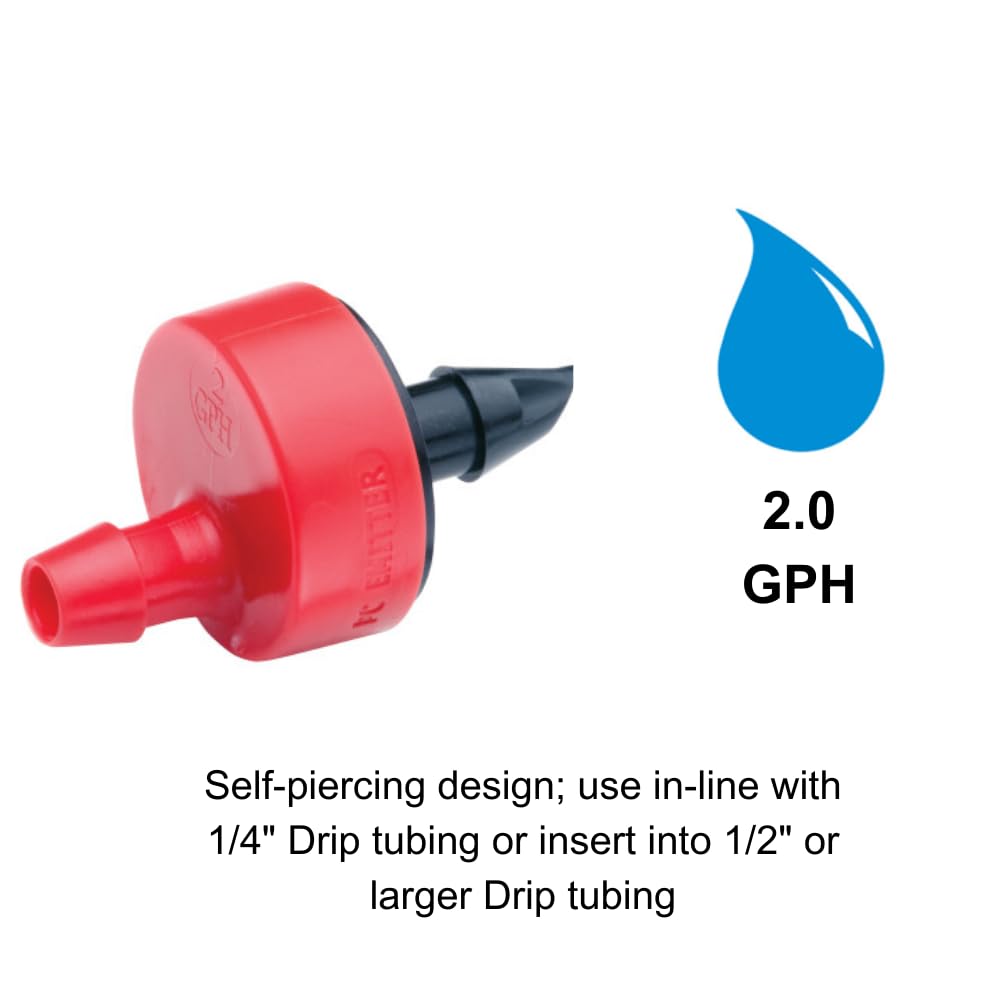
If you’ve ever watched a drip system run and wondered whether you’re actually watering your plants or just the soil between them, you’ve already identified one of the most common — and most expensive — mistakes in residential irrigation design. A drip emitter is a small device (usually a button or flag stake) inserted into a supply line that delivers water drop-by-drop directly to the root zone of a plant. Emitter spacing is simply the distance between those devices along the line. The number sounds like a detail, but it determines whether water stays near plant roots, washes past them, or pools uselessly in a wet-dry checkerboard pattern. Get it wrong and you’re either overwatering the gaps or underwatering the plants — sometimes both in the same bed. This guide walks through the soil science and crop-demand math that practitioners need to dial in spacing before specifying components or placing a supply order.
Why Soil Type Is the First Variable You Set
Before crop type, before emitter flow rate, before anything else: soil texture dictates how water moves once it leaves an emitter. This is the variable most installers underweight because it’s invisible.
Water leaving a drip emitter doesn’t fall straight down like a column. It spreads outward through the soil matrix in a wetting pattern — the three-dimensional shape water occupies as it saturates the pore spaces around plant roots. The geometry of that wetting pattern is almost entirely controlled by soil texture.
Sandy soils have large particles with large pore spaces. Water moves fast and mostly downward. In a typical sandy loam, a 1 GPH (gallon per hour) emitter running for 30 minutes creates a narrow, deep wetting bulb — roughly 8–10 inches wide at the surface and 14–18 inches deep, per UC ANR’s drip irrigation guidance for home landscapes. Implication for spacing: emitters in sandy soil need to be placed closer together — typically 12–18 inches on center — to create overlapping wetting bulbs that wet the entire root zone rather than leaving dry columns between emitter points.
Clay soils have tiny particles packed tightly. Water infiltrates slowly and spreads laterally much more than it sinks. The same 1 GPH emitter in a clay or clay-loam soil creates a wide, shallow wetting bulb — often 18–24 inches across and only 8–12 inches deep. The lateral spread is doing the work. Implication for spacing: emitters in clay can and should be spaced farther apart — 18 to 24 inches on center is defensible, and in heavy clay, 24-inch centers are appropriate for row crops and densely rooted annuals.
Here’s the design error the title references: installers trained on sandy-soil rules who apply 12-inch emitter spacing to a clay-loam bed. In clay, 12-inch centers mean your wetting bulbs overlap by 6–12 inches on every side. You’re applying double or triple the water to the overlapping zone. The result is surface ponding, anaerobic root conditions, and significant runoff — exactly what drip is supposed to prevent. The Irrigation Association’s best management practices specifically flag over-emitter-density in fine-textured soils as a leading cause of excess applied water in residential systems.
The Loam Middle Ground
Loam soils — the balanced mix of sand, silt, and clay that most vegetable gardeners aim for — behave predictably between the extremes. Wetting bulbs in loam run 12–18 inches wide and 10–16 inches deep under a 1 GPH emitter. Standard 12-inch centers in loam are often appropriate, which is why they became the default rule. The problem is that most residential beds aren’t pure loam, and even amended raised beds change character year over year as organic matter breaks down and clay content (from topping off) accumulates.
Practical check before you spec: Dig a test hole 12 inches deep in the bed you’re designing. Ball up a fist of soil. If it ribbons between your fingers without crumbling, you’re in clay territory and you should push spacing to 18–24 inches. If it won’t form a ribbon at all, you’re in sandy territory and 12-inch centers (or closer) are appropriate. Utah State University Extension’s drip irrigation guide for home gardeners recommends this field ribbon test as a first-pass soil classification tool that requires no equipment.
Crop Water Demand: The Second Variable
Once you’ve established soil-driven wetting bulb geometry, plant water demand tells you how many emitters per plant (or how many emitters per linear foot of row) you need to deliver enough water per watering cycle.
This is where practitioners conflate two separate questions: “Where do I put emitters?” (spacing geometry, answered by soil) and “How much water do I need to deliver?” (volume, answered by crop demand and emitter flow rate). Mixing them up leads to systems with the right spacing but the wrong runtime — or vice versa.
Crop Demand Tiers
UC ANR groups landscape and food-garden plants into three rough demand tiers for drip design purposes:
Low-demand plants (established shrubs, native perennials, drought-tolerant groundcovers): often served adequately by a single 1 GPH emitter per plant, or by inline drip line at 18–24 inch centers. The goal is supplemental, not primary, water delivery.
Medium-demand plants (most vegetable crops during establishment, fruit trees, roses): typically require 2 GPH total per linear foot of root zone. For a tomato plant with an 18-inch root spread, that’s two 1 GPH emitters placed at the outer edge of the root ball — not at the stem.
High-demand crops during peak season (sweet corn, cucumbers, squash, melons): may require 3–4 GPH per plant in a hot inland climate. Fine Gardening’s drip irrigation guidance notes that squash and melons in particular develop large, fast-expanding root zones that make emitter placement a moving target — a design argument for inline dripline rather than point-source emitters.
The Emitter Placement Rule That Matters as Much as Spacing
Practitioners know this but it bears stating explicitly: for seedlings and transplants, emitters placed at stem-base don’t encourage lateral root development. The recommended practice (per UC ANR) is to place emitters 6–8 inches outward from the stem at transplant, then add a second emitter farther out (at the expected mature drip line) within the first growing season. This single adjustment accounts for a large share of establishment failures in drip-irrigated food gardens.
By the Numbers: Wetting Bulb Width by Soil Texture
| Soil Texture | Wetting Bulb Width (1 GPH emitter, 30 min) | Recommended Emitter Spacing |
|---|---|---|
| Sandy / sandy loam | 8–10 inches | 12 inches on center |
| Loam | 12–18 inches | 12–18 inches on center |
| Clay loam | 18–22 inches | 18–24 inches on center |
| Heavy clay | 20–26 inches | 24 inches on center |
Sources: UC ANR drip irrigation guidance; Utah State University Extension drip irrigation for home gardens. Wetting bulb widths are approximate and vary with emitter flow rate, soil moisture at time of irrigation, and irrigation duration.
Inline Dripline vs. Point-Source Emitters: Where Each Wins
The spacing discussion changes character depending on whether you’re designing around inline dripline (factory-installed emitters molded into the tubing at fixed intervals, such as Netafim Techline or Rain Bird XFS) or point-source emitters (individual barbed emitters you insert into 1/2-inch supply line at chosen intervals).
Inline dripline ships in pre-set spacing configurations — commonly 6, 9, 12, or 18 inches. The spacing is locked at purchase, which means soil-type matching happens at the ordering stage, not in the field. Manufacturers like Netafim publish spacing recommendations by soil texture in their product documentation; the 12-inch option is optimized for loam-to-sandy-loam conditions, and the 18-inch spacing is explicitly positioned for clay-heavy soils. Buying the wrong spacing configuration for your soil type is the single most common ordering mistake in this product category — and it’s non-correctable without replacing the line.
Point-source emitters in a header-and-lateral layout offer field-adjustable spacing — you punch a hole where you need it. This works well for widely spaced shrubs or irregularly placed perennials but becomes unwieldy in dense vegetable beds where you’d need emitters every 12–18 inches across 100+ linear feet of row.
For raised beds with mixed crops at varying densities, a hybrid approach works: inline dripline at 12–18 inch centers running parallel across the bed, with point-source emitters added at transplant locations for any high-demand crops (tomatoes, squash) that need additional GPH beyond what the inline line delivers.
Pressure Regulators and Flow Rate: The Spec Variable That Breaks Spacing Math
No spacing discussion is complete without flagging that emitter flow-rate specs assume a specific operating pressure — typically 15–25 PSI at the emitter. Most residential supply lines arrive at the drip valve at 45–80 PSI. Without a pressure regulator (a small inline device that drops incoming pressure to the emitter-rated range), a 1 GPH emitter can discharge at 2–3 GPH, rendering your wetting-bulb geometry calculations inaccurate and creating the runoff and ponding conditions you designed the system to avoid.
The EPA’s WaterSense program notes that pressure mismatches are among the most common causes of residential irrigation overwatering, and that adding a pressure regulator is one of the highest-ROI retrofits in any drip system.
For practitioners specifying Netafim PC (pressure-compensating) dripline: the pressure-compensation range on the flagship Techline CV product is 7–70 PSI, which provides meaningful self-correction across a wide supply range. For non-PC inline dripline (Rain Bird DripLine, Raindrip standard options), a 25 PSI regulator immediately downstream of the zone valve is the appropriate spec. This isn’t optional on any municipal supply.
The Decision Rule: If X, Then Y
Here’s the practical framework for spacing decisions before you finalize a component order:
If you’re in sandy or sandy-loam soil: Specify inline dripline at 12-inch centers, or point-source emitters at 12–15 inch intervals. Do not go wider — dry columns will open between wetting bulbs faster than you expect.
If you’re in true loam (or heavily amended raised-bed mix): 12–18 inch centers are appropriate. Match to row or plant spacing — 12-inch centers for dense crops like lettuce or carrots, 18-inch for tomatoes and peppers.
If you’re in clay loam or heavier: Specify 18–24 inch centers. Order inline dripline in the 18-inch spacing configuration, not the 12-inch default. The 12-inch option will deliver 50% more water per linear foot than your clay soil can accept between irrigation cycles.
If your bed is mixed or you’re not sure: Start with 18-inch centers and run your system for three cycles before adjusting. Over-density in fine soils is harder to correct (it means pulling and replacing line) than under-density (which you can fix by adding point-source emitters at problem spots).
In all cases: Install a 25 PSI pressure regulator at the valve, verify emitter flow rates after installation with a catch-can test, and account for soil-type changes if your property has been selectively amended across different zones. A clay-heavy side yard and a raised-bed vegetable area in amended mix are two different soil types — they need different spacing specifications even if they share a zone controller.
Spacing is not a number you borrow from a neighbor’s install or a generic plan sheet. It’s a calculation that starts with your soil and ends with your plants. Getting it right before you order is the difference between a system that works and one that looks like it works while quietly overwatering half your root zone.