May 10, 2026 • Maria Russo • 10 min reading time • Prices verified June 24, 2026
Drip Manifolds Decoded: How to Use Orbit and Rain Bird Distribution Manifolds to Build Clean, Serviceable Drip Zones
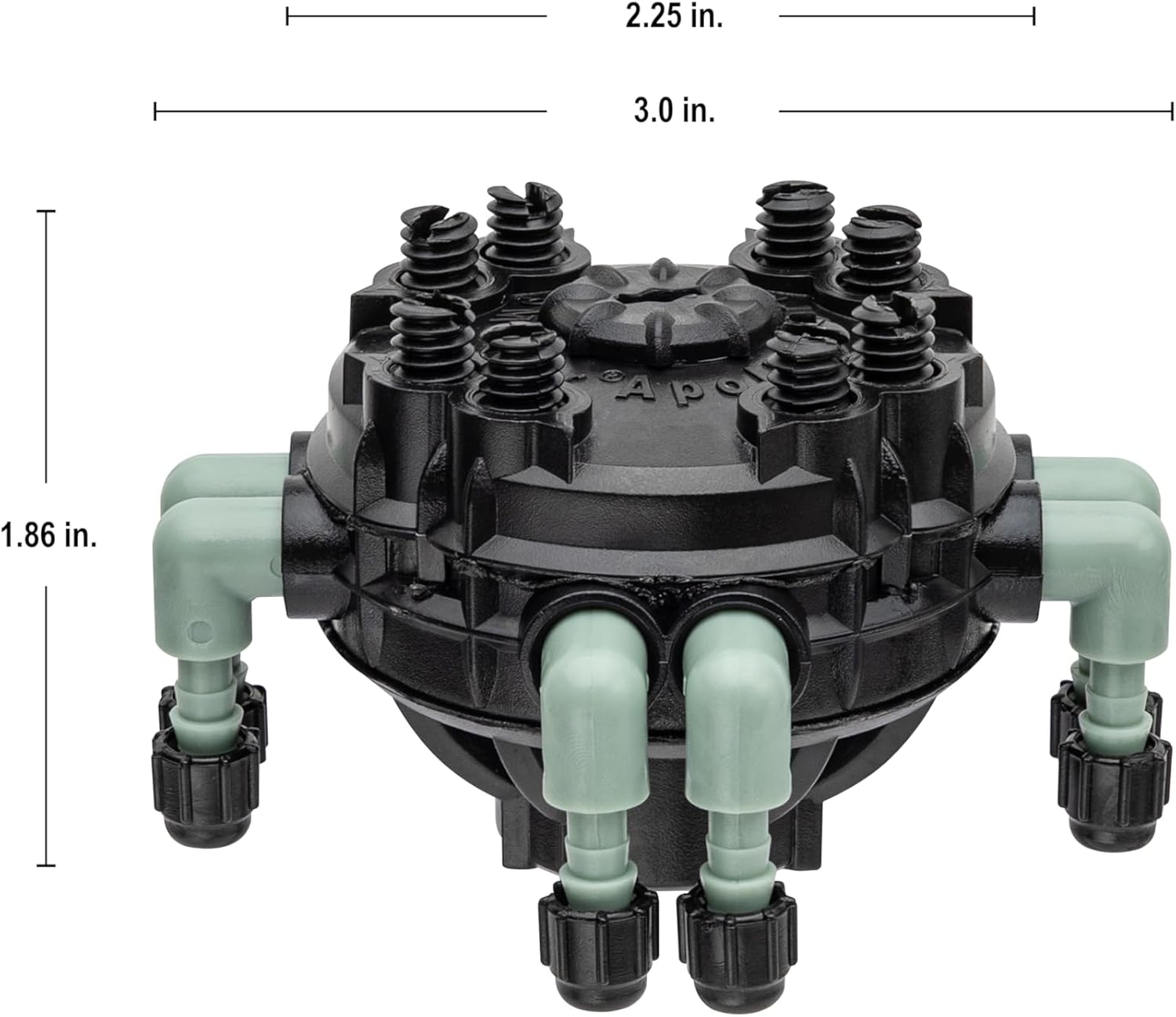
If you’ve ever tried to run six individual drip lines off one ¾-inch supply hose using a pile of barbed tees, you already know what a plumbing rat’s nest looks like. A distribution manifold — sometimes called a drip manifold or header block — solves that problem by acting like a small central hub: water enters from one side and splits cleanly into multiple outlets, each of which feeds its own drip line or emitter. Think of it as a power strip for water. Instead of daisy-chaining connections (each one a potential leak point), you make a single supply connection and branch out in as many directions as the manifold allows. The result is a system that’s faster to build, easier to troubleshoot, and — critically — designed to be modified later without rebuilding from scratch. In this guide you’ll learn how to pick between the main manifold families, how to size them against your actual zone demands, and when the Orbit approach and the Rain Bird approach represent genuinely different tradeoffs rather than just brand preference.
Why Manifolds Matter More Than Most Installers Admit
The core problem with barbed-tee chaining is cumulative pressure loss. Every inline tee fitting creates a minor restriction, and in a long daisy chain the emitters at the far end are operating at meaningfully lower pressure than those near the supply. That pressure differential directly affects flow rate — most pressure-compensating emitters need to see 15–45 PSI to deliver their rated GPH accurately. Per the University of California Agriculture and Natural Resources’ drip irrigation guide (ANR Publication 21579), distribution uniformity — the measure of how consistently every emitter in a zone receives the same amount of water — degrades sharply when inlet pressure at individual emitters varies more than about 20% from design pressure. Manifolds counteract this by creating a shared high-pressure chamber from which all outlets draw simultaneously, equalizing inlet conditions across every lateral.
There’s also the serviceability argument. Installers who’ve done this for a season or two know that zones get changed. A bed that was ornamentals becomes vegetables; spacing requirements shift; a homeowner adds a tree. With a tee-chain layout, adding an outlet means cutting the line and inserting another fitting — risking a compromised joint in an existing buried run. A manifold with capped spare outlets lets you add a lateral by uncapping a port and threading in a new barbed adapter. That’s a 60-second change versus a 30-minute dig.
Orbit vs. Rain Bird: The Core Manifold Architectures
Orbit’s Distribution Manifold Family
Orbit’s primary manifold line (the 67980 and 67981 series, per their published product spec sheets) uses a molded-block design available in 4-outlet and 8-outlet configurations. The body accepts standard ¾-inch FHT (female hose thread) or ¾-inch NPT supply connections depending on the model, and individual outlets are typically ¼-inch barbed for direct insertion of ½-inch poly tubing with a barbed adapter, or straight ¼-inch micro-tubing.
What the specs tell you: Orbit’s manifolds are rated for operating pressures up to 100 PSI at the block, though the Irrigation Association’s Landscape Irrigation Auditor Training Manual recommends running residential drip zones no higher than 30 PSI at the point of emission — meaning you’ll want a pressure regulator upstream regardless of the manifold’s rated ceiling. Orbit’s blocks are compact (most run around 6 inches wide for an 8-port version), making them practical for in-ground valve boxes.
The honest tradeoff: Orbit’s manifold outlets are fixed — they’re molded into the block. You can cap unused ones with the included plugs, but you can’t swap outlet sizes or convert to a different barb diameter without an adapter. Owners in aggregated product reviews consistently flag the outlet plugs as the weakest point in the design; the friction-fit caps can loosen under sustained pressure cycling if not secured with thread seal tape. Treat every capped port as a maintenance checkpoint during your first season.
Rain Bird’s Drip Zone Distribution Architecture
Rain Bird approaches manifolds differently at the mid-range. Their drip zone kits (notably the DRIPZONE series components) center on a header assembly — a length of ½-inch polyethylene supply tubing fitted with pre-punched outlet positions, used in conjunction with their own barbed fittings and optional manifold risers. At the higher end, Rain Bird’s commercial-leaning XFD series and their DRZ drip zone kits include modular block manifolds that use interchangeable outlet inserts, letting you mix ¼-inch micro-tubing outlets with ½-inch laterals on the same block.
Per Rain Bird’s Drip Irrigation Design Guide, their block manifolds are sized for zone flows up to roughly 30 GPH per outlet at design pressure, with the block itself handling up to 8 GPM total throughput — well above what most residential drip zones will demand. That overhead matters when you’re running high-density planting beds where emitter counts push into the 30–50 range per zone.
The honest tradeoff: Rain Bird’s modular approach gives you more configuration flexibility, but it adds SKU complexity. You’re likely purchasing a base block plus separate outlet inserts plus supply fittings, whereas Orbit’s block arrives ready to use. If you’re building a single 4-zone raised-bed system, Orbit’s all-in-one packaging wins on speed and cost. If you’re pre-specifying a 12-zone whole-yard system where some zones are drip and others might transition to micro-sprays, Rain Bird’s modular architecture earns its complexity.
Sizing Your Manifold: The Math You Need Before You Buy
Manifold selection fails most often at the sizing stage, not the brand-selection stage. Here’s the decision framework:
Step 1 — Count your emitters per zone. A typical raised-bed zone might run 12–20 emitters at 0.5–1.0 GPH each. A shrub border might run 8 emitters at 2.0 GPH each.
Step 2 — Sum zone GPH and convert. Divide total zone GPH by 60 to get GPM. A 20-emitter zone at 1.0 GPH = 20 GPH ÷ 60 = 0.33 GPM. That’s a light load any residential supply line can handle.
Step 3 — Check supply-side pressure after regulation. The EPA WaterSense landscape guide and the IA Auditor Manual both recommend a dedicated pressure regulator set to 25–30 PSI for drip zones fed from a municipal supply running 50–80 PSI. Size the regulator before sizing the manifold; the manifold’s rated pressure is downstream of this device.
Step 4 — Match outlet count to zone count, not emitter count. Each manifold outlet feeds one drip lateral (a run of ½-inch tubing with emitters punched in or installed inline). A 4-outlet manifold handles 4 laterals. If your bed design calls for 3 parallel rows, a 4-outlet block gives you one spare — the right call.
By the Numbers
| Manifold Type | Outlets | Typical Supply Size | Max Flow (rated) | Approximate Price Range (2026) |
|---|---|---|---|---|
| Orbit 67980 (4-port) | 4 | ¾” FHT | ~4 GPM | $12–$18 |
| Orbit 67981 (8-port) | 8 | ¾” FHT | ~8 GPM | $18–$28 |
| Rain Bird DRZ block | 4–8 (modular) | ¾” NPT | ~8 GPM | $25–$45 |
Prices reflect mid-2026 market conditions and will vary by retailer.
Building a Clean, Serviceable Manifold Assembly
The difference between a professional-looking installation and a DIY tangle usually comes down to three decisions made before the first fitting is threaded.
1. Put the manifold in an accessible valve box
Manifolds installed in a recessed valve box (the standard 6-inch or 10-inch rectangular boxes used for zone valves) can be accessed, adjusted, and inspected without disturbing mulch or soil. This Old House’s drip irrigation installation guidance consistently emphasizes accessible service points as a hallmark of maintainable systems. Bury the box flush with grade, not below it — water pools in low-set boxes.
2. Thread the supply connection with PTFE tape and a secondary lock
Every threaded connection on a manifold should get two wraps of PTFE (thread seal) tape in the direction of thread engagement before assembly. Manifold blocks see repeated pressure cycles — on at zone start, off at zone end — and untaped threads will weep within one season in freeze-thaw climates. Add a nylon lock nut or a compression fitting on the supply inlet for added security if the manifold will be buried.
3. Cap unused ports with secured plugs, not bare friction caps
Orbit’s included plug caps are friction-fit by design. For any capped port that will see sustained pressure (i.e., any port on a live manifold that you’re not using yet), wrap the plug threads or shank in PTFE tape before insertion, or replace with a threaded barbed plug. Rain Bird’s threaded insert system handles this more elegantly out of the box — another case where their slightly higher price point earns its keep in a permanent installation.
Integration with Smart Controllers: The Zone-Assignment Question
If your manifold feeds a zone that’s controlled by a Rachio 3, Hunter Hydrawise HC, or Rain Bird ST8I-WIFI smart controller, the manifold itself is hydraulically upstream of the zone valve — it’s just plumbing. But the way you design your manifold zones affects how well the controller’s water-use analytics and ET (evapotranspiration — the amount of water plants use based on weather conditions) scheduling can optimize your runtime.
Smart controllers calculate run times based on precipitation rate (how fast a zone applies water, measured in inches per hour) and the soil/plant profile you assign. A manifold zone that mixes high-flow shrub emitters with low-flow vegetable drip in the same valve zone defeats the controller’s scheduling logic — it can’t simultaneously optimize for two different water demands. The Irrigation Association’s training manual describes this as a hydraulic conflict that reduces distribution uniformity at the system level even when the manifold itself is perfectly balanced.
The decision rule: Each manifold outlet cluster that shares meaningfully different plant types, emitter flow rates, or soil conditions should be on its own valve zone. Resist the temptation to cram your entire raised-bed garden onto a single zone to save a valve. The Rachio 3’s zone-level scheduling is only as accurate as the hydraulic segmentation you give it to work with.
If X, Then Y: The Decision Framework
If you’re building 1–3 raised-bed zones with a fixed layout and a limited budget: Orbit’s 4-port or 8-port block manifolds are the practical choice. Purchase one extra plug per unused port and treat each with PTFE tape. Total materials cost per manifold assembly should land well under $40 including fittings.
If you’re designing a 4–8 zone whole-garden system where zone types may evolve: Rain Bird’s modular drip zone manifolds justify their price premium. The outlet insert flexibility means you’re not buying new manifold hardware when a shrub border zone gets converted to micro-spray heads.
If you’re pre-specifying for a licensed contractor installation: Specify both the manifold brand/model and the valve box size in your scope document. Contractors will substitute equivalent components if specs are loose; locking in the manifold model ensures the serviceability decisions you’ve made survive the installation handoff.
If you’re integrating with a smart controller: Design manifold zones around plant type and emitter flow rate, not around geographic convenience. One valve, one plant profile. The ET scheduling accuracy you paid for in a premium controller is only recoverable at the zone-design stage — not after the manifolds are in the ground.
A drip manifold isn’t a glamorous component. It doesn’t appear in product launch announcements or smart-home integrations. But it is the structural decision that determines whether your drip system stays serviceable for a decade or becomes an archaeology project every time you need to add a lateral. Get the manifold architecture right before the first barb goes in, and the rest of the system becomes a series of straightforward extensions on a solid foundation.