June 1, 2026 • Maria Russo • 8 min reading time • Prices verified June 24, 2026
WiFi Hose Timers for Yards Without In-Ground Wiring: When a Smart Faucet Timer Beats a Full Controller
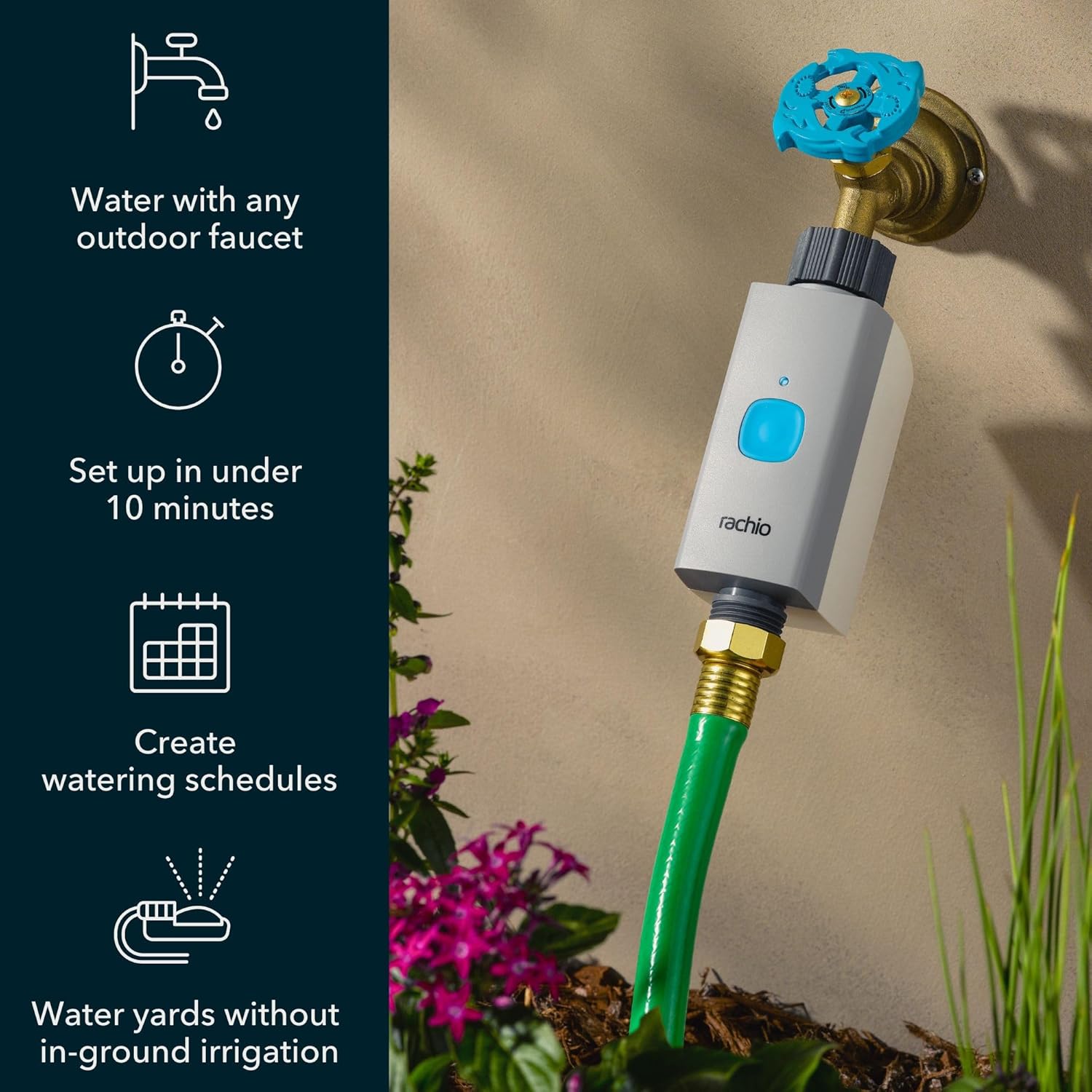
If you’ve ever stood at your outdoor faucet — the threaded spigot on the side of your house, also called a hose bib — and wondered whether you really need to trench wires through your lawn and hire a contractor just to stop hand-watering your raised beds, the answer is often no. A WiFi hose timer (sometimes called a smart faucet timer or Bluetooth hose timer) screws directly onto that outdoor spigot, connects to your home wireless network, and lets you schedule, pause, or trigger watering from your phone. No wiring, no valve manifolds, no permit in most jurisdictions. For a specific set of yard situations, it’s not the budget compromise — it’s the correct answer. But that set of situations is narrower than the marketing makes it look, and buying the wrong tier of device for your actual yard will cost you either money or frustration. This guide maps the decision clearly: here’s what WiFi hose timers can and can’t do, how they stack up against entry-level smart controllers on real numbers, and the decision rules to apply before you click buy.
What WiFi Hose Timers Actually Are (and Aren’t)
A WiFi hose timer is a battery-powered solenoid valve — a valve that opens and closes using electrical current — with an onboard wireless radio and scheduling firmware, packaged to thread onto a standard ¾-inch hose bib. The best-known names in this category as of mid-2026 include the Orbit B-hyve XD, the Rachio Wireless Flow Meter companion (used alongside their controller, not standalone), the LinkTap G2S, and several Melnor WiFi models. Prices run roughly $40–$90 per unit at retail.
The critical word is unit. Each timer controls exactly one valve — one hose outlet. Your in-ground controller controls 6, 8, or 12 zones from a single device because it uses low-voltage wiring to trigger separate solenoid valves buried at each zone. A hose timer has no wiring infrastructure to leverage. If you want to water three separate garden beds on independent schedules, that’s three timers, three separate app devices, and three sets of batteries to track.
That’s not a knock — it’s the load-bearing architectural fact that drives every tradeoff below.
What they do well:
- Single-point watering: one drip line, one soaker hose, one zone of spray heads fed from a single hose bib
- Yards with no existing irrigation infrastructure and no appetite to install it
- Rental properties where you cannot trench or modify landscaping
- Supplemental zones: a vegetable garden on a different side of the house than the main controller
- Seasonal temporary setups (frost-season rollout, pop-up garden beds)
Where they break down:
- Multi-zone scheduling from one device (it cannot do this physically)
- High flow rates: most WiFi hose timers are rated for 1.5–3 GPM (gallons per minute) maximum, which is enough for drip systems and soaker hoses but insufficient for full-coverage rotary or spray heads across a large area
- Freeze protection: battery-operated units in climates below 32°F need to be removed seasonally; they don’t drain lines the way a backflow preventer assembly on a dedicated system can
- Water budget adjustments tied to local ET (evapotranspiration) data — some units now offer weather-based skips via app, but the sophistication gap versus a Rachio 3 or Hunter Hydrawise remains significant
The Real Comparison: WiFi Timer vs. Entry-Level Smart Controller
Here’s where practitioners make the mistake: they benchmark a $60 WiFi hose timer against a $279 Rachio 3 and declare the timer a no-brainer for cost. That’s the wrong comparison frame. The right frame is total system cost for your specific yard, including installation.
By the numbers (mid-2026 retail estimates):
| Path | Hardware | Installation | Total (1 zone) | Total (3 zones) |
|---|---|---|---|---|
| WiFi hose timer (per zone) | $50–$85 | $0 (DIY) | $50–$85 | $150–$255 |
| Entry smart controller + valve | $180–$220 (controller) + $25–$40/valve | $200–$400 (contractor, 3-zone) | $405–$660 | $455–$740 |
For a single zone — one raised bed, one drip circuit — the hose timer wins on total cost by a factor of 4–8x, assuming you don’t already have in-ground wiring. The math inverts once you cross roughly three zones, because at that point you’re buying multiple timers, multiple app instances, and you’re approaching the installed cost of a properly wired 6-zone system that will serve you for 15–20 years.
Utah State University Extension’s landscape irrigation scheduling guidance makes this explicit: system design decisions should be made based on the total number of irrigation zones needed, not just the lowest upfront cost per device. A system undersized for the yard’s actual zone count creates coverage gaps that damage plants and waste water through compensatory hand-watering.
When a WiFi Hose Timer Is the Correct Answer
Stop treating this as a compromise. For the right yard, a WiFi hose timer is the optimal specification. Here’s the decision filter:
You have 1–2 discrete watering needs, not a whole-yard coverage problem. A vegetable garden and a container patio. Two raised beds side by side on the same hose. A single soaker hose looped through a perennial border. One timer per hose bib, one hose bib per zone, two zones total — this is the device’s sweet spot.
You have no in-ground wiring and no appetite to install it. The EPA WaterSense program’s outdoor water use data consistently identifies residential outdoor irrigation as the largest discretionary water use category, averaging 9 billion gallons per day nationally. Precisely because that number is so large, getting some automation in place — even a single timer — has meaningful impact versus hand-watering erratically or over-watering by default. Perfect is the enemy of automated.
You’re on a rental property or have seasonal use. This Old House’s hose-end timer installation guide notes that hose bib timers require no permanent modification to the plumbing system — they thread on and off like a garden hose. That makes them the only practical smart watering solution in most rental or seasonal contexts.
You want app scheduling and weather-based skips, not multi-zone management. The Orbit B-hyve XD app (widely reviewed positively for its UX clarity) allows rain-delay scheduling, run-time programming, and manual override from your phone. The Melnor WiFi timer offers similar functionality. The Irrigation Association’s Smart Irrigation Month resources note that weather-responsive controllers — including simple timer-based systems that skip watering after rainfall — can reduce residential outdoor water use by 15–50% compared to fixed-schedule manual systems. Even a modest hose timer with a rain-skip feature captures most of that benefit.
Your flow requirements are within the device’s rated capacity. This is the spec check most buyers skip. A standard drip system running ¼-inch distribution tubing with pressure-compensating emitters typically flows 0.5–1.5 GPM — well inside a WiFi timer’s rated range. A soaker hose circuit similarly stays under 2 GPM. But if you’re planning to run a set of pop-up spray heads from a hose bib, check the combined precipitation rate (the total water volume delivered per hour across all heads) and convert to GPM before buying. Most WiFi timers will throttle or fail above 3 GPM. Landscaping Network’s drip irrigation design guide recommends calculating total emitter flow before selecting any upstream control device.
When You Should Wire Up Instead
The hose timer is not the answer in these scenarios, and it’s worth naming them explicitly:
Whole-yard coverage with 4+ zones. At this point, the multi-timer cost approaches the controller + installation cost, and you permanently lose centralized scheduling, unified water budgets, and the firmware upgrade path that controllers like the Rachio 3 and Hunter Hydrawise receive annually.
Spray head or rotor circuits. Standard pop-up spray heads and MP Rotators are sized for system pressure (typically 30–45 PSI at the head) and flow rates that require proper zone valves and controller infrastructure. Feeding them from a hose bib with a timer is possible in small configurations but produces uneven distribution — the Family Handyman smart irrigation overview flags pressure inconsistency as the top DIY mistake in hose-bib-fed spray systems.
Smart home platform integration at depth. Rachio’s API integrates with Amazon Alexa, Google Home, Apple HomeKit, and IFTTT with published documentation. Some WiFi hose timers offer Alexa compatibility, but the integration depth — zone naming, water history export, flow anomaly alerts — is not comparable. If you’re building a smart home ecosystem and irrigation is part of that stack, a proper controller is the right node in the network.
Long-run ROI justification. Properly installed in-ground systems with smart controllers have a documented effect on home resale perception in water-scarce markets (per landscape industry trade data). Hose timers, by definition, leave no permanent infrastructure investment.
The Decision Rule
If your situation maps to any of the following, a WiFi hose timer is the buy to make right now:
- 1–2 zones, no existing wiring, DIY installation, garden or drip application → WiFi hose timer, $50–$85 per zone, done.
- Rental or seasonal property → WiFi hose timer, remove in winter, no regrets.
- Supplemental zone added to an existing controller-managed yard → WiFi hose timer for the outlier zone; no need to rewire.
If your situation maps to any of these, step up to a wired controller:
- 3+ zones needed, or likely needed within 18 months → Run the wiring now. Installation labor doesn’t get cheaper; having a contractor come back for a second visit doubles your labor cost.
- Spray heads or rotors in the circuit → You need the pressure management and flow capacity of a proper zone valve setup.
- Smart home integration matters to you → A Rachio 3 or RainBird ST8I-WIFI gives you the platform depth a hose timer cannot match.
The honest framing: WiFi hose timers are not a gateway product on the way to a real system. They’re the right product for a specific use case that millions of yards actually have. Know which yard is yours, run the zone count, check the flow math — and buy the device that solves the actual problem, not the one with the most features per marketing dollar.