May 11, 2026 • Maria Russo • 8 min reading time • Prices verified June 24, 2026
Rain Bird ARC6 and ESP-TM2 WiFi: The Mid-Tier Rain Bird Controllers Worth Specifying for 6–12 Zone Residential Systems
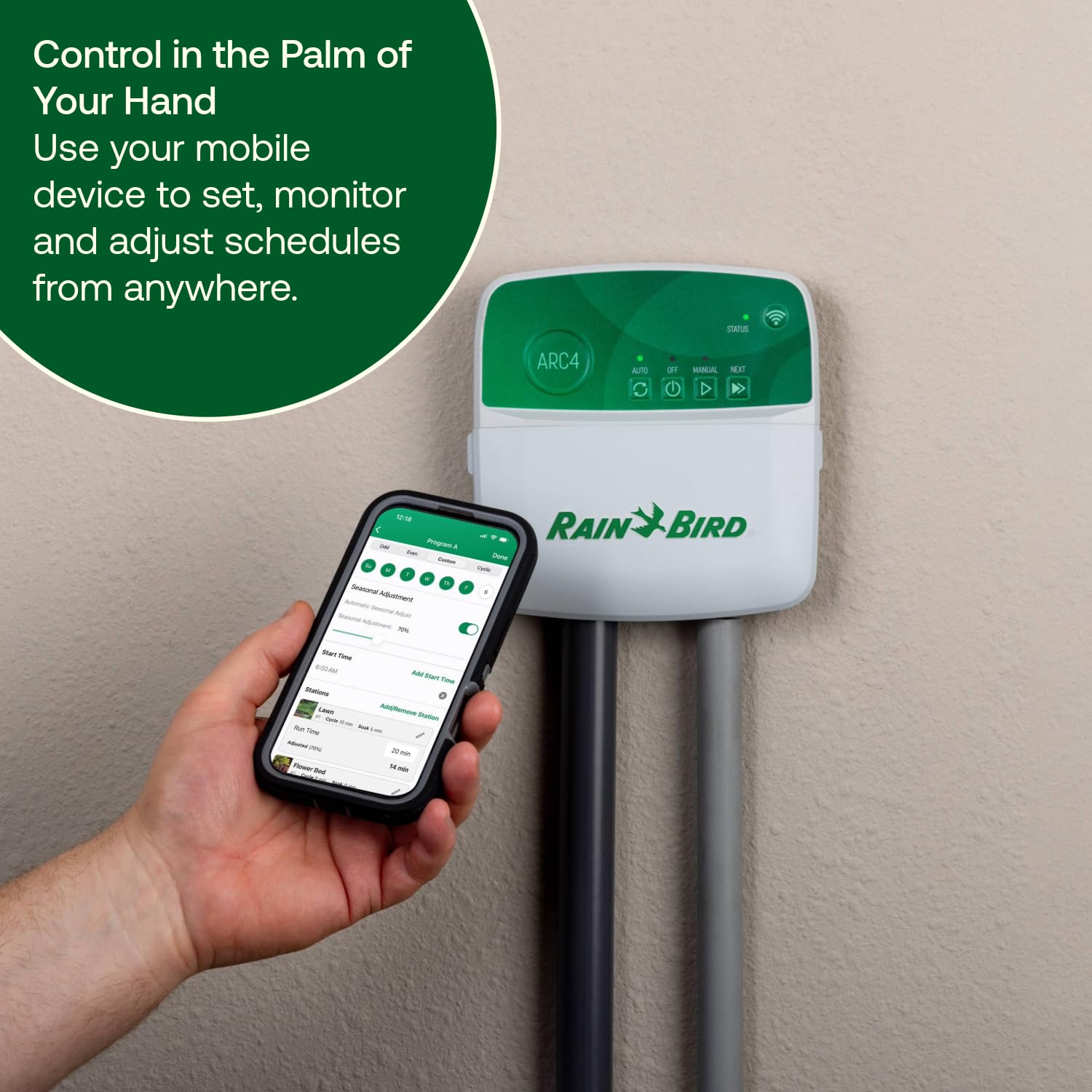
If you’ve ever stood in a big-box store staring at a wall of irrigation controllers — those gray or white boxes that act as the “brain” of an in-ground sprinkler system, telling each zone of your yard when and how long to run — you know the choice gets complicated fast. A controller handles anywhere from 4 to 24 independent zones (think: front lawn, back lawn, drip garden beds, slope plantings), and the jump from a basic dial-timer to a WiFi-connected “smart” unit is where most homeowners either overspend or under-buy. Smart controllers earn that label by adjusting watering schedules automatically based on real weather data — rain, evapotranspiration (ET, which is how much water soil and plants lose to heat and wind), and seasonal temperature shifts — rather than just running on a fixed timer. This article looks specifically at two Rain Bird controllers that live in the practical middle of the market: the ARC6 and the ESP-TM2 WiFi. If you’re specifying a 6–12 zone residential system and want to understand where each model earns its price tag, what you give up at each tier, and which one fits your actual situation, read on.
What You’re Actually Choosing Between: ARC6 vs. ESP-TM2 WiFi at a Glance
Rain Bird has long dominated the professional irrigation market — you’ll find their rotors, valves, and controllers on everything from suburban lawns to commercial sports fields. But within their residential lineup, the ARC6 and ESP-TM2 WiFi occupy meaningfully different positions, and conflating them is one of the most common specification mistakes seen in the mid-range residential segment.
The ARC6 is Rain Bird’s entry into app-connected, weather-responsive control at a modest price. It supports up to 6 zones, connects via WiFi to the Rain Bird app (compatible with Amazon Alexa voice control), and holds EPA WaterSense certification — meaning it meets the EPA’s documented standard for weather-based scheduling that reduces outdoor water use by an average of 15% compared to traditional timers, per the EPA WaterSense Labeled Controller Requirements and Testing Protocol. The ARC6’s retail price as of mid-2026 sits in the $80–$110 range, making it one of the most affordable WaterSense-certified smart controllers on the market.
The ESP-TM2 WiFi (the “TM2” generation with the LNK WiFi module installed or built-in, depending on variant) is Rain Bird’s workhorse for 6–12 zone professional-grade residential installs. It’s the controller you’ll see irrigation contractors spec as a default for whole-yard systems in the $800–$2,000+ build range. Retail pricing runs $180–$250 depending on zone count (6-station and 12-station versions exist) and whether the LNK2 WiFi module is included or purchased separately (~$30–$40 add-on for older-stock units).
By the Numbers
| ARC6 | ESP-TM2 WiFi | |
|---|---|---|
| Zone capacity | 6 | 6 or 12 |
| WiFi smart scheduling | Yes (built-in) | Yes (via LNK2 module) |
| EPA WaterSense certified | Yes | Yes |
| Flow sensor compatibility | No | Yes |
| Seasonal adjust (manual %) | Yes | Yes |
| Retail price range (2026) | $80–$110 | $180–$250 |
| Master valve / pump start | Yes | Yes |
Where the ESP-TM2 Earns Its $100 Premium
For a practitioner specifying a system rather than just shopping, the price gap only matters if you understand what you’re buying with it. Let’s name the tradeoffs explicitly.
Flow sensor support is the biggest functional delta. The ESP-TM2 is compatible with Rain Bird’s FS series flow sensors — devices installed in the main supply line that measure actual water flow in gallons per minute. When a pipe breaks, a head gets snapped off by a mower, or a valve sticks open, the flow sensor detects the anomaly and the controller shuts down the affected zone and sends an alert. The ARC6 has no flow sensor input whatsoever.
For a homeowner with a 6-zone front-and-back lawn system in a water-rate-sensitive market, flow monitoring is not a luxury. Per the Irrigation Association’s Smart Controller Best Practices Guide, a single stuck-open valve can waste 10,000–25,000 gallons before a homeowner notices on their water bill. If your client or your own property has any history of valve issues, is on a well pump with pressure sensitivity, or sits in a municipality with tiered water pricing (where overages trigger penalty rates), the ESP-TM2’s flow-sensor compatibility pays for itself in one prevented incident.
Zone expandability matters at specification time in ways that aren’t obvious until renovation happens. A 6-zone ARC6 is a closed box — when your client wants to add a drip zone for a new raised bed or a dedicated zone for a new sod installation, the controller is the bottleneck. The 12-station ESP-TM2 gives you room to grow. This Old House’s smart controller reviews consistently flag “room to expand” as one of the top reasons contractors default to higher-capacity units even on smaller initial installs — it avoids a controller swap on the second visit.
Contractor preference and serviceability also favor the ESP-TM2. Its wiring terminal layout, programming interface, and app ecosystem are more familiar to licensed irrigation contractors who’ve installed dozens of them. When a homeowner calls a contractor to troubleshoot or expand the system two years post-install, the ESP-TM2’s documentation trail and the installer’s muscle memory matter. Landscaping Network’s irrigation controller buying guide specifically notes that “contractor-familiar platforms reduce diagnostic labor time” — a practical consideration if you’re pre-specifying before handing off to a licensed installer.
Where the ARC6 Makes Sense — and When to Spec It Without Apology
There’s a version of this article that treats the ARC6 as a consolation prize for people who can’t afford the ESP-TM2. That framing is wrong, and it would send the wrong buyers toward a $250 controller they don’t need.
The ARC6 is a genuinely well-engineered product for its target use case. Family Handyman’s irrigation controller coverage highlights it as a strong pick for homeowners converting from a basic mechanical timer who want app-based scheduling and weather response without the complexity of a professional-grade interface. If the install is:
- 6 zones or fewer, definitively (no expansion planned)
- No existing flow sensor infrastructure and no budget to add one
- Owner-operated with no plans to hand off to a contractor
- Budget-constrained in a project where saving $120–$140 on the controller means properly funding a pressure regulator and backflow preventer on the drip side
…then the ARC6 is not a compromise. It’s the correct specification. It holds WaterSense certification, which satisfies rebate eligibility requirements in most utility conservation programs (check your local utility’s rebate list — EPA WaterSense certification is the qualifying threshold for most municipal rebates). It connects to the same Rain Bird app ecosystem, supports Alexa voice commands, and handles seasonal ET-based scheduling.
For the weekend DIYer scaling up from a hose-timer setup, the ARC6 is also a natural anchor point. It handles the controller side of a properly engineered system at a price that leaves budget for the components that actually do the water-distribution work — pressure-compensating emitters, a quality backflow preventer, filter, and pressure regulator for drip zones.
The Subscription Question (And Why Rain Bird’s Answer Is Currently a Competitive Advantage)
In mid-2026, the smart irrigation controller market is mid-conversation about subscription fees. Rachio has maintained a meaningful free tier for core smart scheduling, but its premium features (flow monitoring analytics, advanced reporting) are bundled into paid tiers. Hunter Hydrawise’s Enthusiast plan changes in late 2024 pushed more feature access behind a paywall for higher zone counts.
Rain Bird’s app platform — used by both the ARC6 and ESP-TM2 — currently requires no ongoing subscription for full smart scheduling functionality, including weather-based ET watering adjustments, seasonal scheduling, and flow alerts (on ESP-TM2 with a flow sensor installed). This is not a permanent guarantee; vendor pricing models evolve, and this site monitors those changes monthly. But as of this writing, the Rain Bird ecosystem’s zero-subscription stance is a meaningful differentiator at specification time, particularly for property owners who will own the system for 10+ years and don’t want to budget for recurring SaaS fees on top of a $1,500 irrigation install.
For the smart-home integrator segment, it’s worth noting that Rain Bird’s native Alexa integration is functional on both controllers, but Google Home and Apple HomeKit native support remains absent from Rain Bird’s current platform as of mid-2026. If a client’s smart home is anchored to HomeKit or Google Home and they want irrigation integrated into their automation routines without a third-party bridge, this is a genuine gap. Rachio 3’s broader platform integrations are a legitimate reason to steer that specific buyer away from Rain Bird entirely — no amount of hardware quality closes a missing API.
The Decision Rule
After working through the specs and tradeoffs, here’s the clean if/then framework:
If your system is 6 zones or fewer, no flow sensor planned, owner-operated, and the $120 savings gets reinvested into better drip components or backflow hardware → specify the ARC6. It’s the right tool, not the cheap one.
If your system is 7–12 zones, involves a licensed contractor install, has any flow sensor requirement, or serves a property where the owner is likely to expand zones within 3–5 years → specify the ESP-TM2 WiFi in the 12-station configuration. The premium is justified by flow monitoring capability, expansion headroom, and contractor familiarity.
If the client’s priority is deep smart-home platform integration (HomeKit, Google Home) or best-in-class water-use analytics → Rain Bird’s platform is not the strongest choice at either price point. Rachio 3 deserves a separate comparison at that decision branch.
If local utility rebates are part of the budget math → confirm WaterSense certification eligibility on your utility’s rebate list before specifying either controller; both qualify under current EPA standards, but rebate amounts and eligibility caps vary significantly by region.
The Rain Bird ARC6 and ESP-TM2 WiFi are both honest, well-documented products in a market that has plenty of overpromised ones. Knowing which job each is built for — and being willing to say so plainly to a client or to yourself — is what separates a good specification from an expensive mistake.