June 1, 2026 • Maria Russo • 10 min reading time • Prices verified June 24, 2026
Preassembled Valve Manifolds Compared: Orbit, Hunter PGV, and Rain Bird 100DVF for Whole-Yard Zone Builds
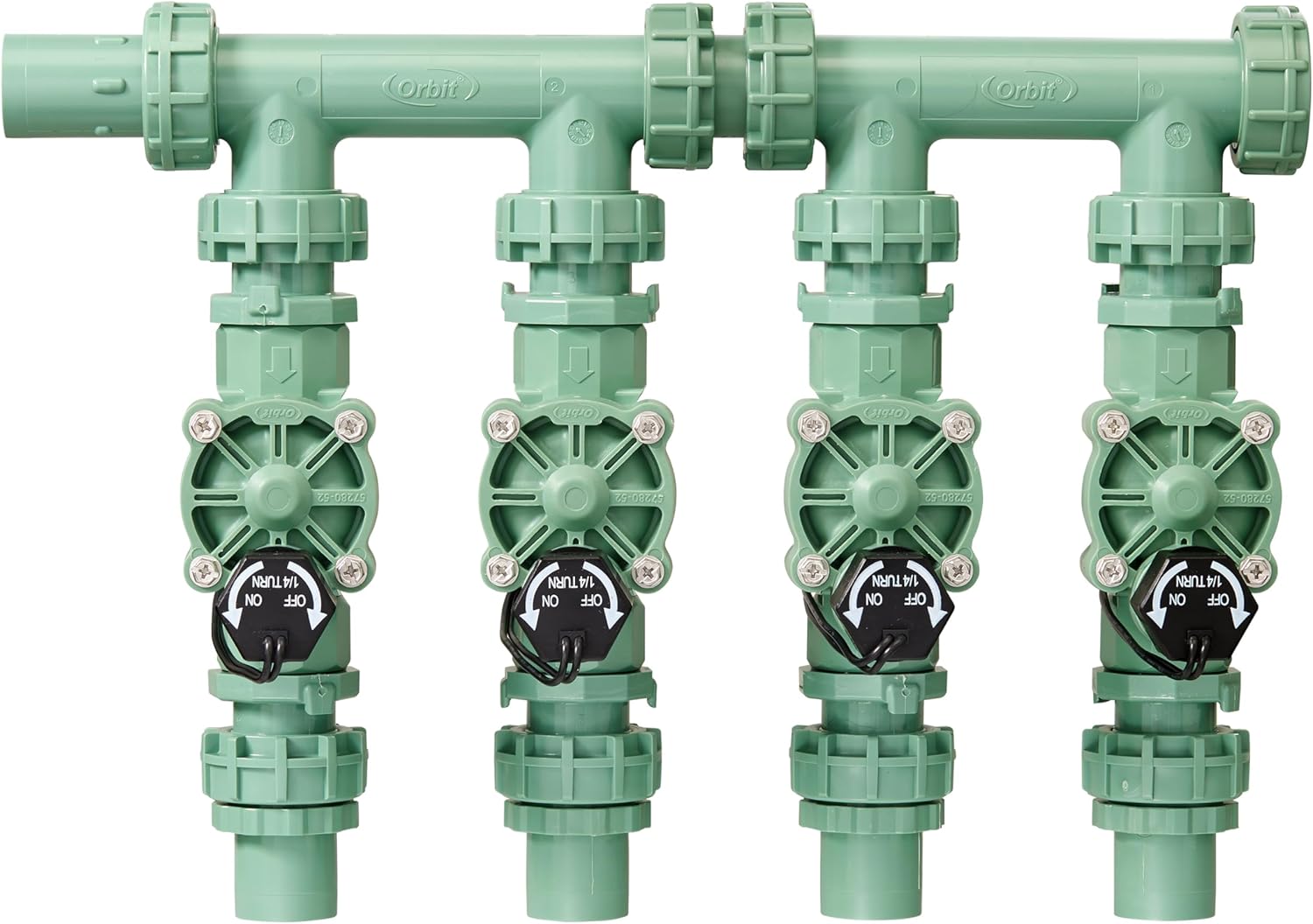
If you’re planning an irrigation system that covers multiple areas of your yard — a lawn zone, a shrub bed, a drip zone for raised beds — you’ll eventually arrive at the same piece of hardware: a valve manifold. A manifold is simply a cluster of control valves (the electromechanical gatekeepers that open and close water flow to each zone) pre-assembled onto a shared supply header, so your controller can address every zone from a single plumbing connection point. Instead of burying four separate valves in four separate boxes around the yard, you consolidate everything into one valve box or manifold enclosure. It’s cleaner, easier to service, and essential for any system with more than two zones. This guide compares three manifold options that keep coming up in real buying decisions: Orbit’s pre-manifolded assemblies (the budget-accessible entry), Hunter PGV-based manifolds (the mid-to-pro workhorse), and the Rain Bird 100DVF (the commercial-leaning alternative with a distinctive flow-path design). By the end, you’ll have a clear decision framework tied to your actual system pressure, zone count, and serviceability needs.
What the Manifold Decision Actually Controls (And What It Doesn’t)
Before the brand comparison, it’s worth separating the manifold decision from the valve decision — because they’re not always the same thing.
A manifold is a configuration, not a product category. You can buy a preassembled manifold from a brand like Orbit or Rain Bird that arrives as a single unit, or you can build a custom manifold by threading individual valves (Hunter PGV, Rain Bird DVPE, etc.) into a PVC or poly header you assemble yourself. The preassembled route trades some flexibility for installation speed and dimensional predictability. The custom-build route lets you mix valve types, choose any zone count, and optimize for your specific pressure conditions — but adds an afternoon of solvent welding and thread sealing.
For most residential whole-yard builds in the $800–$2,000 range, the preassembled manifold wins on installation time, especially when you’re handing the final connection to a licensed contractor who bills by the hour. For a semi-pro self-install or a system you plan to expand in phases, the custom approach gives you more room to maneuver.
According to the Landscaping Network’s Irrigation Zone Design Guide, the most common residential manifold configuration is 4–6 zones on a shared 1-inch supply line, which maps cleanly to the product formats all three brands offer.
How the Three Options Compare at a Glance
| Feature | Orbit (Preassembled) | Hunter PGV Build | Rain Bird 100DVF |
|---|---|---|---|
| Typical street price (4-zone) | $45–$75 | $110–$160 | $90–$130 |
| Max rated flow (per valve) | 0.5–16 GPM | 0.5–20 GPM | 0.5–22 GPM |
| Working pressure range | 15–150 PSI | 20–150 PSI | 15–150 PSI |
| Solenoid serviceability | Limited | Full | Full |
| Flow control included | No | Yes | Yes |
| Best fit | Budget, uniform zones | Mixed zones, long-term | High-flow, marginal water |
Prices reflect May 2026 aggregated retail. Spec data sourced from the Hunter Industries PGV Series Valve Technical Reference Manual and Rain Bird Corporation 100DVF Series Valve Specification Sheet.
The Three Options, Head to Head
Orbit Preassembled Manifolds: Speed Over Serviceability
Orbit
$57.62
In stock on Amazon
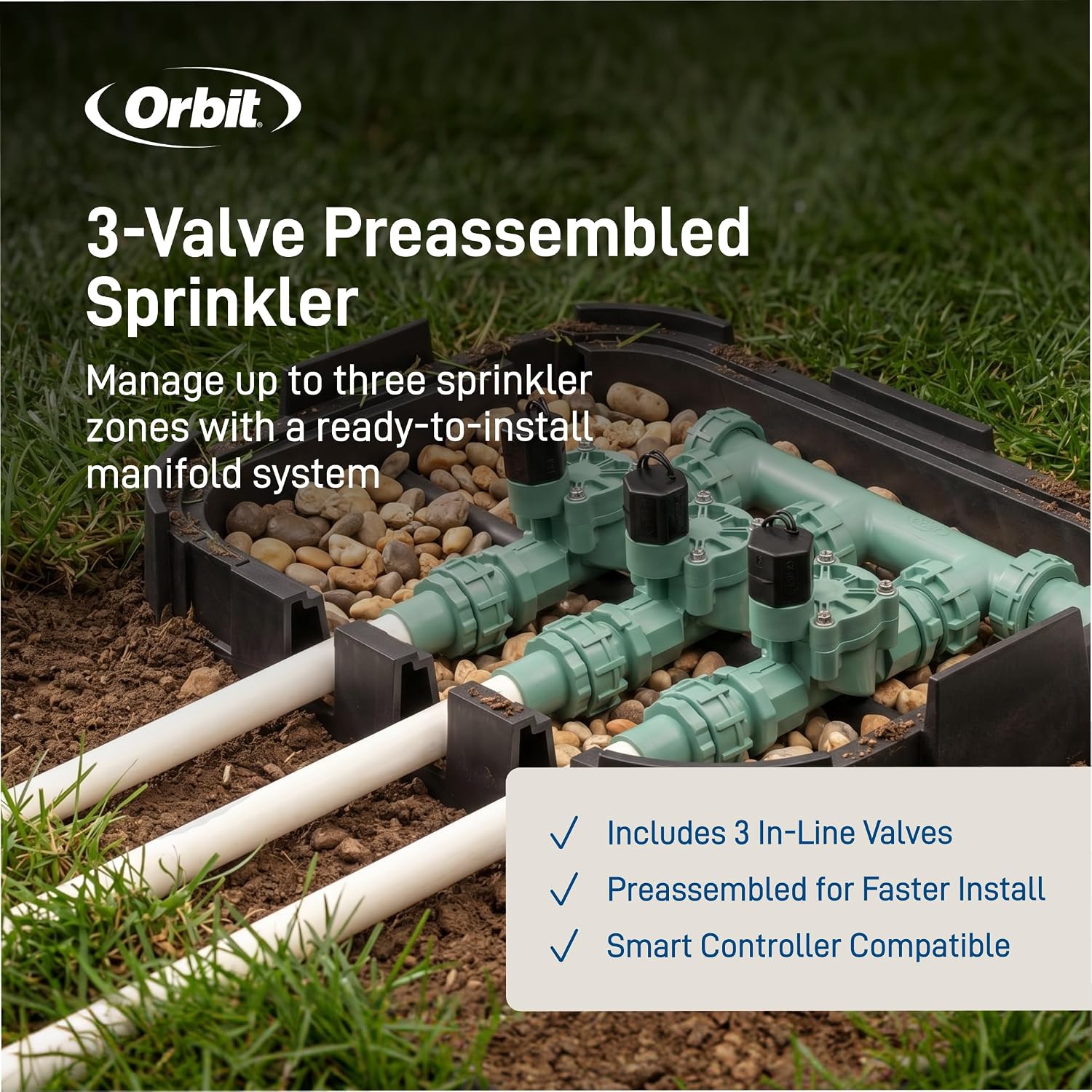
Check price on AmazonOrbit’s preassembled manifold units — typically offered in 3- and 4-zone configurations — arrive as complete assemblies with valves, manifold body, and fly-lead wiring already terminated. Installation is genuinely fast: two pipe connections (supply in, zone outlets), connect the zone wires to your controller, and you’re done. For a homeowner installing their first system over a weekend, that matters.
The tradeoff is locked-in configuration. The valves in a preassembled Orbit manifold are integrated into the manifold body, which means a failed diaphragm — the internal rubber membrane that controls water flow — often means replacing the full assembly rather than a $6 rebuild kit. For a five-year system on a rental property where “replace and move on” is a reasonable philosophy, that’s defensible. For a system you plan to run for 15 years across multiple growing seasons, it becomes a liability.
Pressure behavior is the other honest limitation. Orbit’s manifold valves are rated to 150 PSI, which covers most residential supply lines, but the integrated body design makes it harder to diagnose pressure drop across individual zones without additional gauging ports. If your system has mixed emitter types — MP Rotators on one zone, drip on another — you’ll want per-zone flow control, which Orbit’s preassembled units typically don’t include.
Utah State University Extension’s publication Residential Irrigation System Design notes that for basic residential systems under five zones with matched precipitation rates — meaning each head in a zone applies water at roughly the same inches-per-hour rate — simplified valve assemblies are often entirely appropriate. Orbit fits that window well.
Where Orbit wins: a 3- or 4-zone residential system with uniform emitter types, a budget ceiling under $100 for the manifold assembly, and an owner who values speed over long-term serviceability. Accept the replacement-vs-repair trade when it fails in year six.
Orbit
$57.62
In stock on Amazon
Check price on AmazonHunter PGV-Based Manifolds: The Default Specification for a Reason
Hunter
$157.84
In stock on Amazon
Check price on AmazonThe Hunter PGV is one of the most widely specified valves in North American residential and light commercial irrigation, and the reason is serviceability depth. The PGV’s solenoid (the electromagnetic coil that triggers the valve to open), diaphragm, and flow control stem are all individually replaceable without removing the valve body from the manifold. In a system buried 12 inches down in a valve box, that matters enormously — you’re pulling a $12 solenoid, not excavating a manifold assembly.
Per the Hunter Industries PGV Series Valve Technical Reference Manual, the PGV is rated from 0.5 to 20 GPM, which accommodates everything from a low-volume drip zone running 0.5 GPM to a full-coverage rotor zone running multiple Hunter PGP or Rain Bird 5000-series heads. The flow control dial on each valve body lets you manually throttle flow — useful when a zone’s dynamic pressure (pressure under flow conditions) exceeds your emitter manufacturer’s recommended operating range.
Building a Hunter PGV manifold requires assembling individual valve bodies onto a common header — typically 1-inch Schedule 40 PVC or Schedule 80 for higher-pressure applications — using female-threaded inlets and standard solvent-weld or compression fittings. It adds time and skill demand to installation, but the resulting assembly is modular: add a zone two seasons later, swap a valve body if you change from spray to drip on a zone, or pull a single solenoid for a winter rebuild without touching anything else. This Old House’s guidance on irrigation system installation consistently emphasizes that modular valve assemblies dramatically reduce long-term service costs compared to integrated preassembled units.
Pressure management is where the PGV earns its specification frequency. The Irrigation Association’s Landscape Irrigation Best Management Practices document highlights that distribution uniformity — how evenly water is applied across a zone, where a number closer to 100% means less water waste — degrades sharply when operating pressure falls outside an emitter’s design range. The PGV’s per-valve flow control helps you dial in the pressure each zone actually delivers, rather than relying entirely on a whole-system pressure regulator upstream.
Where Hunter PGV wins: any system where you’re mixing emitter types across zones, planning future expansion, or specifying for a client installation that a contractor will service over multiple seasons. If you’re pre-specifying before handing the job to a licensed irrigator, Hunter PGV is the valve your contractor will have rebuild parts for in stock.
Hunter
$157.84
In stock on Amazon
Check price on AmazonRain Bird 100DVF: The High-Flow Specialist
Hunter
$226.94
In stock on Amazon
Check price on AmazonThe Rain Bird 100DVF occupies an interesting position: technically rated for commercial applications, yet its 1-inch inlet and standard wiring interface make it a straightforward drop-in for ambitious residential builds. Per the Rain Bird Corporation’s 100DVF Series Valve Specification Sheet, max flow is 22 GPM — the highest of the three options compared here — which gives it headroom that neither the Orbit preassembled unit nor the Hunter PGV can match.
The “DVF” designation refers to Rain Bird’s dual-filtered flow control design — a two-stage debris filtration pathway built into the valve body before water reaches the diaphragm seat. In practice, this means the 100DVF shows better longevity in systems sourced from reclaimed water, well water, or any supply with elevated sediment, where unfiltered valves frequently fail via diaphragm pitting or solenoid clogging. Long-run installer field reports consistently note the 100DVF holds up in marginal water quality conditions where competitive valves require more frequent rebuild cycles.
The manifold-build process for 100DVF valves mirrors the Hunter approach — individual valve bodies threaded onto a common header — and Rain Bird’s inline configuration (water enters from one end, exits perpendicular to the body) suits certain manifold orientations better than a side-port design. If your valve box has limited depth, this geometry can matter for fitting clearance during installation.
The honest tradeoff: the 100DVF body is physically larger than a PGV at the same zone count, which affects valve box selection. At $25–$35 per valve body versus $18–$28 for a PGV at May 2026 pricing, a six-zone 100DVF manifold costs meaningfully more than a PGV equivalent. This Old House’s irrigation coverage notes that valve body cost is rarely a system’s largest line item, but it compounds across zone count — on an eight-zone build, the premium adds up.
Where Rain Bird 100DVF wins: well-water or reclaimed-water systems, high-flow zone demands (large rotor zones running eight or more heads), or any build where you’re specifying Rain Bird throughout — Rain Bird 5000 heads, Rain Bird ST8I-WIFI controller — and want a unified ecosystem for parts and warranty support.
Hunter
$226.94
In stock on Amazon
Check price on AmazonThe Decision Framework: If X, Then Y
The three-way comparison resolves cleanly when you map it to actual decision conditions.
If your system is 3–4 uniform zones, budget is tight, and long-term serviceability isn’t a priority → Orbit preassembled manifold. It installs in an afternoon, keeps costs under $100, and is perfectly adequate for simple residential configurations with matched emitter types. Accept the replacement-vs-repair trade when it fails in year six.
If your system has 4–8 zones, mixes emitter types (rotors plus drip plus sprays), or will be serviced by a contractor over multiple seasons → Hunter PGV manifold build. This is the default specification for a reason. Part availability is near-universal, contractor familiarity is high, and per-valve serviceability extends system life meaningfully. Expect to spend $110–$160 for a 4-zone assembly in components.
If your water source is a well or reclaimed supply, your zone flow demands exceed 15 GPM on any single zone, or you’re building inside a Rain Bird ecosystem → Rain Bird 100DVF. The filtration engineering earns its price premium in marginal-water conditions, and the 22 GPM ceiling gives you headroom that a PGV cannot match. Budget $25–$35 per valve body over the PGV baseline and size your valve box accordingly.
One variable that cuts across all three: master valve compatibility. If you’re running a smart controller — Rachio 3, Hunter Hydrawise HC — with a master valve or pump start relay, which adds a whole-system shutoff that the controller activates before any zone opens, confirm your manifold’s supply inlet accepts the master valve’s pressure rating. The Irrigation Association’s Landscape Irrigation Best Management Practices recommends master valve installation as standard practice for any system with a backflow preventer and controller. It’s an inexpensive addition that protects a much larger investment.
The manifold is the structural decision in your zone design. Unlike a smart controller you can swap next season or an emitter you can replace in an hour, the manifold is buried, plumbed in, and there to stay. Get the valve selection right the first time by mapping it to your actual system conditions — zone count, water source, emitter mix, and service model — rather than defaulting to price alone.